If employees have to raise their voices to chat with someone just two metres away, your workplace is likely too loud.
The Health and Safety Executive (HSE) recently launched a major campaign warning employers not to wait until permanent, life-changing damage occurs - like noise-induced hearing loss or debilitating tinnitus.
Managing this isn't just a legal duty under the Control of Noise at Work Regulations 2005; it is an opportunity to protect your team and improve day-to-day productivity.
Workplace noise is a big health and safety issue that affects around one in five workers across the UK and it is estimated that around 15,000 workers develop hearing problems caused or made worse by work each year. In addition, workers can still be exposed to excessive noise levels outside of the workplace, such as at home or in the general environment.
Workplace noise is a big health and safety issue that affects around one in five workers across the UK and it is estimated that around 15,000 workers develop hearing problems caused or made worse by work each year. In addition, workers can still be exposed to excessive noise levels outside of the workplace, such as at home or in the general environment.
Introduction to Noise
Noise is defined as ‘unwanted’ sound which interferes with hearing, communication and can cause a nuisance or damage.
Sound moves as pressure waves through the air and is formed of 3 factors:
Magnitude (Volume) – how loud, measured in decibels (which is a logarithmic scale, meaning that a difference of just 3 decibels represents a doubling or halving of the sound intensity and is represented between 0-130 dB). As the human ear does not hear all frequencies equally, a filter is applied – ‘A’ weighting – shown as dB(A).
Frequency (Pitch) – how fast air pressure fluctuates, measured in Hertz (Hz) – the human ear typically hears frequencies between 20Hz and 20,000Hz (20 kHz).
Duration (Time/variation) – how long the sound lasts and whether continuous or variable.
ampaign breaks the responsibilities down into three manageable phases:
Phase 1 - Assess: identifying all potential sources of noise and who is at risk, and also measuring workplace noise levels.
Phase 2 - Control: Eliminate or reduce the noise at its source rather than jumping straight to earplugs.
Phase 3 - Protect: Provide appropriate gear, clear signage, and training to bridge any remaining safety gaps.
Phase 1: Assess (where is the noise coming from, how much and who?)
For most businesses in sectors like manufacturing, engineering, construction, and agriculture, noise is generated by everyday operations. Common sources include:
Impact and sudden forces: Metal/hard object-on-metal impacts, drop-forging, pneumatic tools.
Continuous machinery: Large fans, conveyor belts, production lines, compressors, generators, and heavy vehicle engines.
Handheld power tools: Grinders, saws, and impact wrenches.
What to do: Walk the workplace, look at all areas. If people are raising their voices or reporting ringing ears (tinnitus) at the end of a shift, you must move onto a formal risk assessment. Use of a mobile noise monitoring app can also give a good indication if required. Look at who may be exposed in specific areas or using specific equipment or tools.
Phase 2: Control (stop noise at the source)
Personal Protective Equipment (PPE) should always be your last line of defence. Organisational and engineering controls should be considered first:
Purchasing policy: When renting or buying new assets, check the manufacturer's decibel specifications and opt for quieter equipment.
Engineering adjustments: Reduce structural vibration by introducing anti-vibration mounts. Line heavy metal chutes with abrasion-resistant rubber to dampen impact noise.
Acoustic isolation: Build simple acoustic enclosures around noisy machinery – or in large areas – an acoustic enclosure for the worker(s).
Workplace Layout: Move noisy equipment away from employees in their work areas or increase the distance between, and limit the time workers spend in noisy areas.
Phase 3: Protect (the "CUFF" checking system)
If engineering cannot be implemented effectively or fully, consideration should be given to provision of hearing protection, however this does have a number of limitations.
Recent HSE inspections uncovered serious gaps in how businesses manage hearing protection, revealing that 80% of employees lacked proper instruction on how to fit ear protection correctly. To combat this, the HSE recommends using the CUFF check to safeguard your workforce:
C – Condition: Ensure earmuffs or plugs are clean, intact, and regularly inspected for wear and tear. Store re-useable items safely between use.
U – Use: Make sure hearing protection is worn continuously in hearing protection zones - taking earplugs out, or lifting/moving muffs away, for even a few minutes dramatically decreases their effectiveness.
F – Fit the ear: Teach staff proper insertion techniques (e.g., rolling disposable foam plugs tightly) and ensure hair, hoods, or glasses don’t break the seal of ear defenders.
F – Fit for purpose: Ensure the protective equipment matches the specific noise levels of your machinery without over-attenuating (which can isolate a worker). This can be achieved by looking at the hearing protection’s Single Number Rating (SNR) – e.g. SNR 37 dB – this figure can then be subtracted from the measured ‘C’ weighted scale (which is likely higher than measured ‘A’ weighted figures).
Note: Ensure your workers can still safely hear fire alarms and vehicle reversing bleeps while wearing their hearing protection.
Control of Noise at Work Regulations 2005
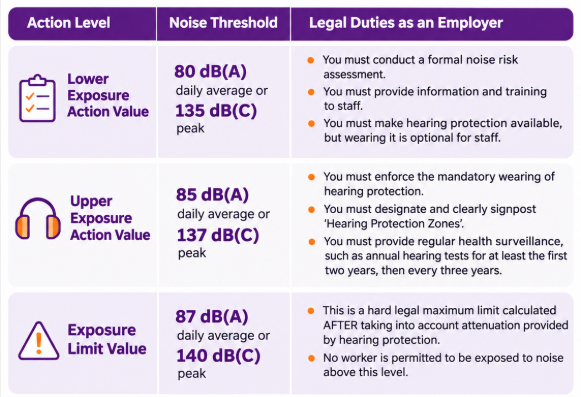
Legal duties are triggered by specific noise levels. Noise is measured in ‘A’ weighted decibels dB(A), and the law focuses on two numbers: the daily average exposure (over an 8-hour shift) and peak noise (sudden, loud bangs). There are three legal thresholds:
To keep businesses legally compliant and workforce protected, the core message of the of the HSE campaign is ‘do not wait until hearing damage is already done’.
Identify any potential noise sources, assess the noise levels and who may be exposed and then implement suitable controls if necessary. Always focus on reducing or controlling the noise at its source first before considering provision of hearing protection. If this is provided, use the CUFF check (Condition, Use, Fit the ear, Fit for purpose) to ensure their protection actually works.